
Original photographs by the author. Urbit Assembly 2022 in Miami.
🛠️
Next week, I’m hosting a Zoom call for crypto developers, creators, and investors curious about building on Urbit. We’ll be joined by ~hodzod-walrus, lead developer of Uqbar. If you’d like to learn more about what we’re building, sign up here.
Once upon a time, the cyberpunk was a marginalized loner living amidst dystopian data streams, synthetic drugs, and modified body parts.
In 2022, after the first great breakthrough of crypto into popular culture, a new wave of Cyberpunk has officially emerged.
But this time, the cyberpunks are different.
The new cyberpunks look and sound different because the new cyberpunks feel different.
Where the old cyberpunks were embattled and beleaguered, the new cyberpunks are relaxed, optimistic, and almost arrogantly pre-triumphant.
Where the old cyberpunks were cold, fast, and nihilist, the new cyberpunks are warm, purposely slow, and often religious.
Where the old cyberpunk builds an artificial womb under the glow of Tokyo neon, the new cyberpunk builds a normal personal computer in an Austin garage before Latin Mass.
Where the old cyberpunk wears a katana and night-vision goggles, the new cyberpunk wears sweatpants, Crocs, and Versace sunglasses. Why? The truth is I’m not sure yet.
All I know is the new cyberpunks are winning, and they look like it.

Petra Cortright, ~folnel-simdur
As the Urbit network grows, more and more journalists come around to see what’s going on, but most of their reports sound the same. Wishy-washy hedging, fake detachment, and moralistic pearl-clutching. “Is Urbit real or fake? Is Urbit good or bad for society?” Lame!
All these journalists come to the Urbit meetups because Urbit is one of the only things in technology right now that is technically remarkable and culturally interesting. They go because they want to go, they go because it’s a weird and wild scene that *they want to be a part of. *And once there, they enjoy themselves without reserve, but then they go home and write some milquetoast review with an air of feigned objectivity and the same “pros and cons” formula as the last one.
Is Urbit real or fake? Is Urbit good or bad for society? I can answer these questions for you right now, once and for all: Urbit is very real and it’s very bad for society—bad for your fake ass society! It’s great for the next society, however. Urbit is for what Giorgio Agamben calls the coming community*.*
Why doesn’t any writer have the balls to visit an Urbit meetup and just write the simple truth, which is that they really wanted to go; it wasn’t like any technology conference they’ve ever been to or heard of; Urbit is monopolizing the most unique and wild engineers and creators; and that, by all appearances, Urbit objectively looks like the beginning of a tidal wave, starting an exponential swell into a cultural and technological revolution?
I can tell you the reason they don’t just say this. It’s because they’re not cyberpunk enough. They visit the Crypt from the Net but they don’t know how to write on the Net what they find in the Crypt.
Well, you know what they say… Be the “scene report” you want to see in the world…
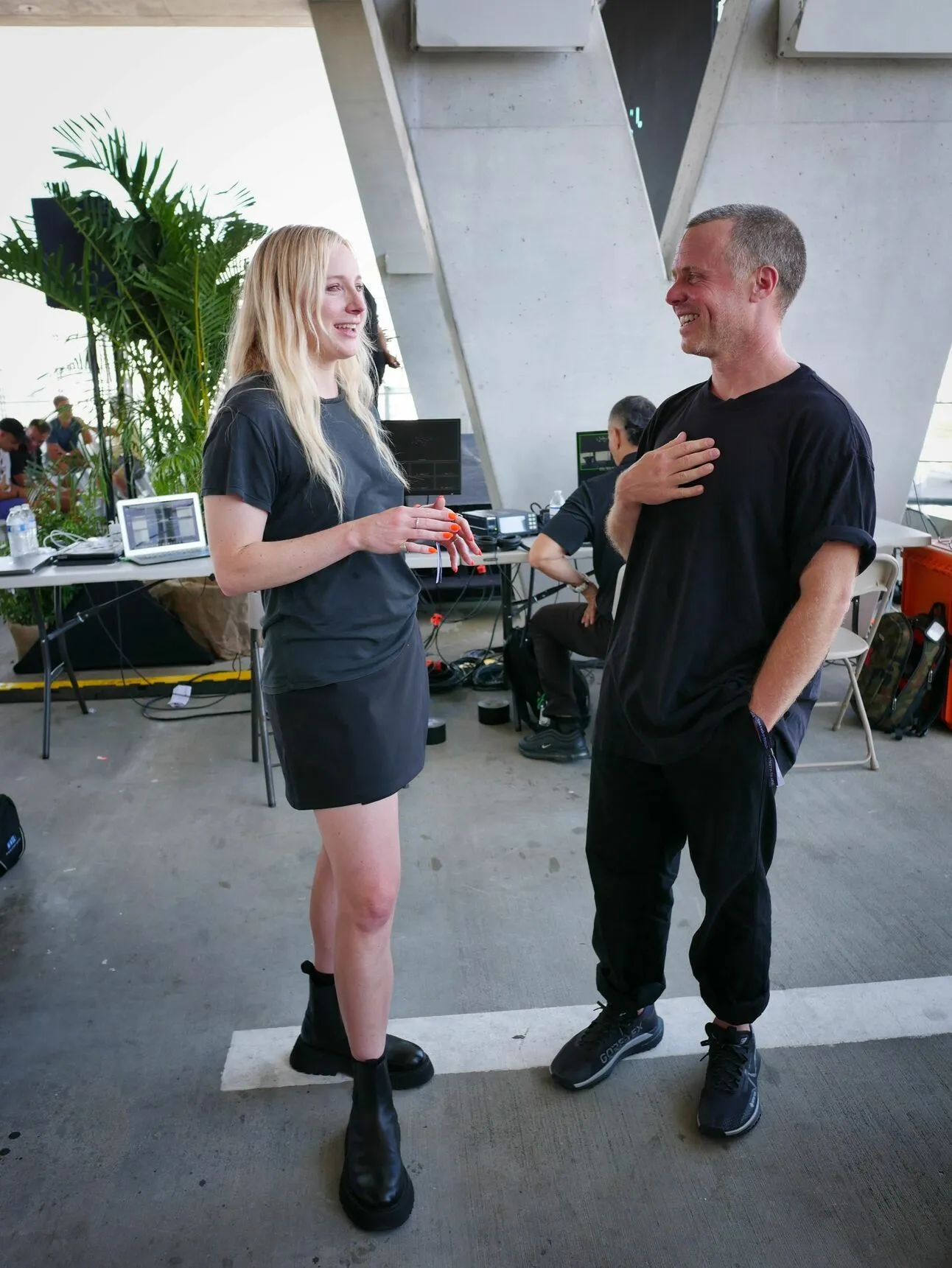
~riprud-tidmel and ~ravmel-ropdyl from Tlon, ~lomder-librun from Holium
Thursday: Meltdown Has a Place for You
I fly into Miami on Thursday.
I’m sharing an Airbnb with three other guys. Two are coming from Argentina.
These guys are in a roaming band of Urbit hackers building Uqbar, a zero-knowledge rollup for Ethereum and the first blockchain built on Urbit. One of them, ~nilrun-mardux from The Network Age podcast, is advising the El Salvador government to pass a “DAO law,” which would make El Salvador the first jurisdiction in the world to really unleash decentralized capital formation for the crypto era.
🎧
You might remember ~nilrun-mardux from Other Life #202, The Harvard Finance Bro Building an Urbit Network State in El Salvador.
The Airbnb looks like the kind of place you would bring a prostitute.
I like it.
I didn’t come to Miami as a journalist. I came to Miami on business.
If the right people come to understand Urbit’s potential, and the right things are built in the right order, it’s quite possible that Urbit could generate billions of dollars in value over the next ten years. Since many people refuse to understand this, Urbit remains a massively asymmetric bet. Over the past year, as I’ve become increasingly convinced about Urbit’s telos*, *I’ve also been re-orienting my little media company accordingly.
By writing what I think about Urbit, I’ve already staked my credibility. If I turn out to be wrong, my credibility will rightly take a hit. So if I turn out to be right, you better believe I plan to get rich. How? Well, it’s not obvious yet. As with any complex and radical technological disruption, it’s a constantly moving landscape of risks and rewards. And that’s why I’m in Miami on the company card.
Journalists with PhDs in the Humanities will sometimes ask if Urbit is a “pyramid scheme” because they don’t understand technology and markets. If you find a billion-dollar technology while it’s still just a ten-dollar technology, there are a dozen ways to get rich from seeing the truth before others. It is natural and correct that late-comers will find it much harder to get rich from the same opportunity, but this doesn’t make something a “pyramid scheme,” unless you think every single public company in the world is a “pyramid scheme.”
People who call Urbit a pyramid scheme are what Nick Land calls *transcendental miserabilists. *They believe they are doomed to be poor and sad forever, so on the off chance that God drops real alpha into their lap, they choose to maintain rather than exit their misery, for misery is their transcendental horizon. In fact, these are the people who need Urbit the most.
If you’ve built your whole adult life on an aesthetics of misery, you realize you can just quit that, right? Get a new pseudonymous identity on a new internet, and reinvent yourself as a happy and confident person excited to build a new future. You don’t have actually to be happy or confident; it’s sufficient to merely pretend, for you to become happy and confident eventually. As Pascal taught, you do not believe and then pray, you start praying and eventually you believe. Your Urbit is a clean-slate computer, but it’s also a clean-slate for your life, and God knows many of you could use that.
After unpacking, my first order of business is to set up my podcast studio. Someone from Twitter had offered me some studio space—a pseudonymous Twitter user named Indan Bronson, who I had never met before in meatspace. The problem is, it’s a little far from my pad.
🎧
You might remember Indian Bronson from Other Life #154, Pseudonymous Decentralization with Indian Bronson.
I decide it won’t work: I’ll just shoot the podcasts in the brothel.
I talk with the guys for a bit.
They make fun of me for having gotten a Covid mRNA vaccination.
I say my wife was pregnant and we wanted to see our grandparents. They say that’s cope.
I say that real men aren’t afraid of some little shot in the arm.
“I’m so fucking strong, they could inject me with anything and it wouldn’t matter,” I tell them.
They say that’s cope, too.
“That’s like getting fucked in the ass to prove you’re not gay,” one of them says.

Name unknown; Katherine Dee; ~fanfyn-walbur
Sitting in this strange Web2 brothel, watching a digital billboard in the living room change adverts every 30 seconds, my masculinity in question for getting vaccinated, I think about the famous line from Nick Land’s cyberpunk political-theory text Meltdown:
“Meltdown has a place for you as a schizophrenic HIV+ transsexual chinese-latino stim-addicted LA hooker with implanted mirrorshades and a bad attitude. Blitzed on a polydrug mix of K-nova, synthetic serotonin, and female orgasm analogs, you have just iced three Turing cops with a highly cinematic 9mm automatic.
In some ways, Land saw it all coming. In other ways, reality always turns out stranger than even the strangest science-fiction can imagine.
We went to an Ecuadorian restaurant. Walking the streets, I’ve never seen so many hot Latina chicks in one place.
Friday: Fifty Trillion Dollars
At Urbit Assembly 2011 in Austin, I did a 10-podcast series. But this time I wanted to hear the talks and not burn myself out, so I resolved to only do a couple podcasts this time.
Friday morning, I wake up early and go to the beach. Standing in the ocean, I look at the skyline. Miami is beautiful, but it reeks of sin. Temptation is everywhere; sex and money are just in the air. I do want to become moderately wealthy, but I want my mind to be pure. Miami makes me want tons of money. I like living in Austin, which is economically thriving but certainly not the sexiest place. Nice restaurants sit in dumpy strip malls, which seems like an ideal environment for moderately wealthy men who wish to keep their minds pure.
First up on the pod is filmmaker Alex Lee Moyer. I’ve known Alex for some time now; our families became friendly during her time in Austin. So this was a no-brainer.

Filmmaker Alex Lee Moyer
At the conference venue, I talk more with ~nilrun-mardux.
“Solving for computers is way bigger than solving for money,” he says.
I like Nilrun because he is one of the few people I consider adequately bullish on Urbit. I shake my head approvingly.
“Bitcoiners say that Bitcoin will reach the market cap of gold, but that’s only about 11 trillion. What’s the total market cap of every big internet company getting rebuilt on Urbit with crypto baked in?”
I say, “I don’t know. How much?”
He thinks for a minute and says:
“Maybe 50 trillion.”
My next podcast is with Asher Penn, the founder and editor of Sex magazine. Independent counterculture magazines like Sex generally do not last very long. The failure rate of indie magazines is high. But Sex has been running for 10 years now, which I find admirable, intriguing, and on-brand for the Other Life podcast.
Asher comes to my makeshift studio. He tells me about the first interview he ever did, with William Gibson. I wonder what William Gibson would think about Urbit.
Sex magazine has nothing to do with sex, I learn. It’s just a good short word that nobody had ever used for a magazine before. Personally, I think sexual liberalism has been a disaster for the human race, but Sex magazine sells some t-shirts with a red line through the word “sex,”* *which I think is cool.
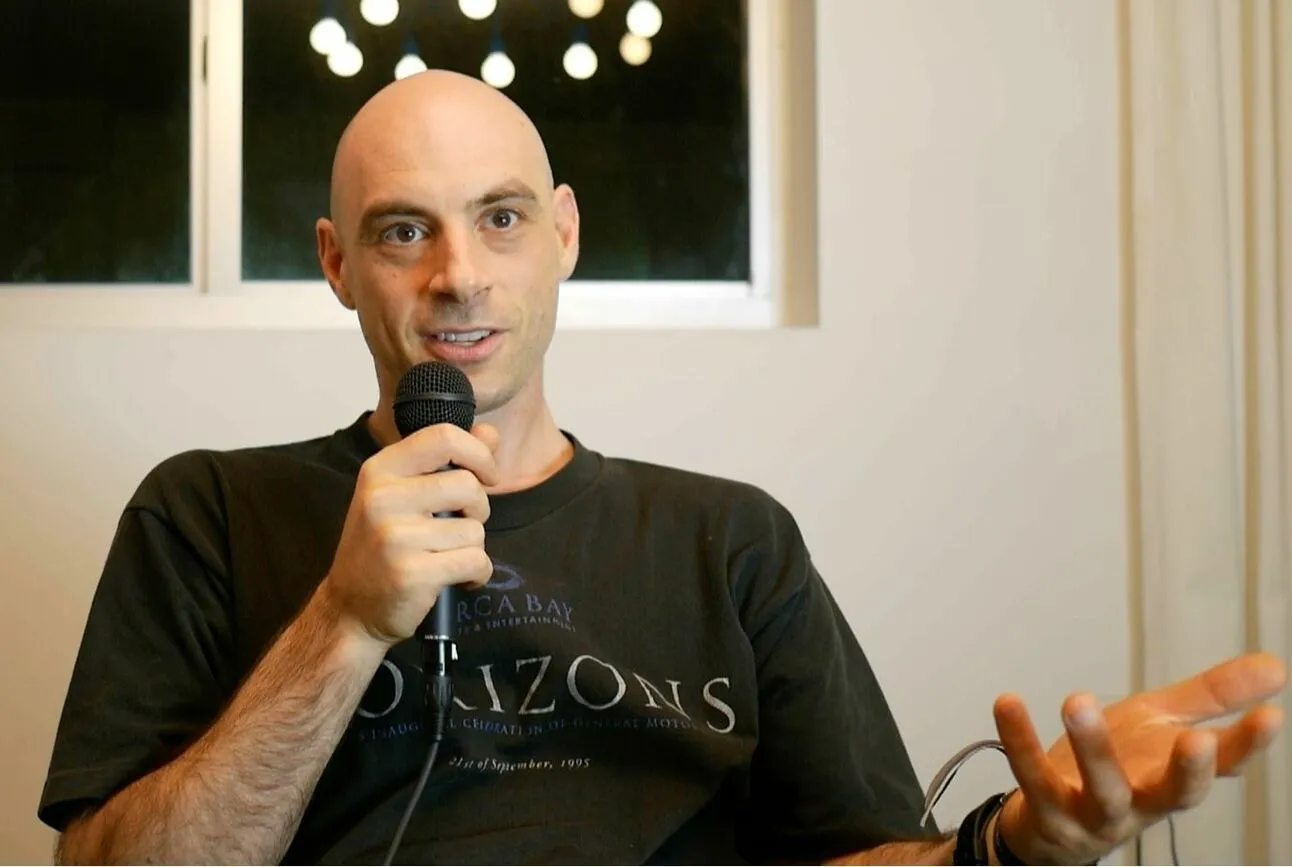
Asher Penn from Sex magazine, Other Life podcast; merch from Sex magazine.
I would not wear a shirt that just says “sex,” but I would wear a shirt that has a red line through it. That a counterculture mag called Sex now offers sex-negative merch says a lot.
Saturday: What Exponentials Look Like
Saturday brings most of the big tech updates. I leave mid-day Sunday, so I miss a few things, like Riva’s well-received closing keynote.
Application sharing on the network has only been possible for one year. Already, Urbit has more than 70 working apps and somewhere around 3-5 startups building on the network.
Native Planet is a new company producing at-home Urbit machines for about $500 a pop.
Uqbar officially ships a public testnet for their Urbit-native ETH L2. You can now write smart contracts manipulating money (fake, for now) and Urbit applications (real) at the same time, on a shared execution layer.
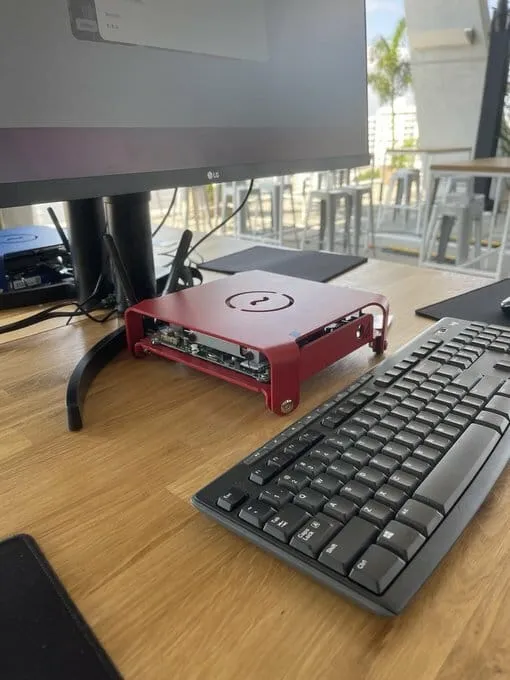
Native Planet’s $500 personal Urbit machine; Ziggurat, an Urbit app for deploying Uqbar smart contracts seamlessly with user-facing computer programs; Tlon’s new UI for Groups.
Tirrel showcases their new system for executing fiat payments on Urbit.
Tlon shows off a complete overhaul of the longest-running and most widely used community interface (Groups), plus an iOS app for DMs; everything is nicer and faster now. Alpha versions are pubicly available for testing now.
Finally, Holium showcases an Urbit desktop client that allows members of a community to blend their computers together over any app. Multiple cursors on anything you want (video). They also showcase a crypto wallet integrated with Urbit Direct Messages (video), among other things.
It’s hard to know in the early stages, but it’s quite possible that this is what exponentials looks like.

Before the conference, I was asked to moderate a panel and also suggest some guests for it. The panel was about America, crypto, and the network state, so I said we have to get Charlotte Fang. Fang is founder of the NFT collective Remilia and ringleader of the retired, infamous net-art project Miya.
🎧
The best explanation of the Miya affair, as it relates to the attempted cancellation of Milady, is Other Life #192, The Bull Case for Milady: Evaluating NFTs and Debunking the Miya FUD with Vers la Lune.
In my opinion, Fang understands the logic of internet culture and its intersection with crypto better than anyone else in the world. Fang doesn’t do many interviews or panels, so I was pleasantly surprised when my invitation was accepted.
During our panel, Charlotte is visibly uncomfortable and struggling to speak. She walks off stage about 10 minutes into the panel.
Some of the journalists mentioned in their reports this mysterious disappearing act, but nobody bothered to ask me about what happened. Charlotte microdosed psychedelic mushrooms that morning, but accidentally macrodosed them instead.
The new cyberpunks don’t take speed and ice a few Turing cops, they just eat mushrooms and walk off the stage.
🛠️
Next week, I’m hosting a Zoom call for crypto developers, creators, and investors curious about building on Urbit. We’ll be joined by ~hodzod-walrus, lead developer of Uqbar. If you’d like to learn more about what we’re building, sign up here.
*Nothing above should be construed as financial advice. I am biased, do your own research. I may consult for, or own tokens in, protocols or companies mentioned in this article. Crypto is volatile and risky, I’m not an expert or financial advisor, etc.